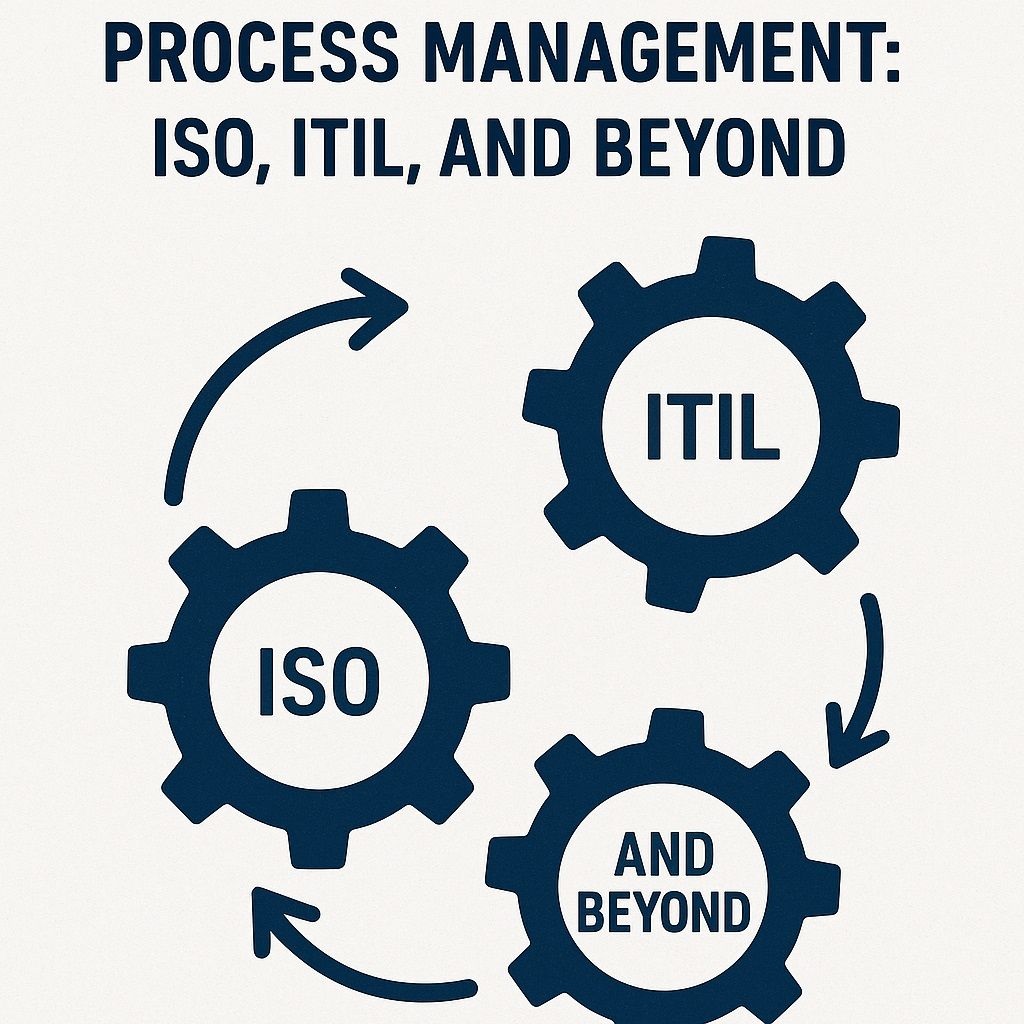
In today’s interconnected and digitally dynamic world, achieving excellence in process management is no longer a luxury but a business imperative. Organisations, irrespective of their size or sector, must ensure that their processes are not only efficient and scalable but also compliant with global standards. The emergence and adoption of process management frameworks such as ISO (International Organization for Standardization) and ITIL (Information Technology Infrastructure Library) have given companies a structured foundation for improving quality, enhancing service delivery, and maintaining global competitiveness. However, the landscape of process management continues to evolve beyond ISO and ITIL, prompting the need for agile, industry-specific, and technology-enabled solutions.
According to the International Organization for Standardization, the ISO 9001 framework provides a globally recognised structure for managing quality and risk in complex process environments. At aa-aspect, this framework was instrumental in guiding our cross-departmental audit alignment in 2023, when we successfully streamlined multiple redundant workflows into a unified compliance model.
Global standards serve as the backbone of structured governance and operational efficiency. They allow businesses to align with international best practices, create consistency across departments and regions, and demonstrate a commitment to excellence to stakeholders and customers. ISO standards, for instance, are globally recognised guidelines that provide a benchmark for quality, environmental responsibility, information security, and more. Meanwhile, ITIL offers a detailed set of practices for IT service management (ITSM) that focuses on aligning IT services with the needs of the business.
The practical impact of adopting these standards can be profound. ISO 9001, the standard for quality management systems, ensures that a company consistently meets customer and regulatory requirements. ITIL’s approach to service strategy, design, transition, and operation enables IT departments to deliver value while managing risk. For industries like manufacturing, aerospace, and finance, such standards are not just recommendations but regulatory requirements.
Yet, one size does not fit all. As business operations become more complex and digitally integrated, traditional frameworks alone may not suffice. This is where companies must look beyond ISO and ITIL to consider lean methodologies, Six Sigma, COBIT (Control Objectives for Information and Related Technologies), and digital transformation standards like CMMI (Capability Maturity Model Integration). These frameworks address the growing need for agility, continuous improvement, cybersecurity, and customer-centricity.
An illustrative example of the challenges and the transformative power of global standards can be seen in a multinational manufacturing client that partnered with aa-aspect. The client faced compliance risks due to fragmented processes and poor integration of IT systems across its facilities in Europe, Asia, and North America. While they had previously implemented ISO 9001 and ITIL, these were done in silos and lacked a cohesive organisational strategy. As a result, the company suffered from data inconsistencies, inefficient workflows, and frequent quality audits failures.
aa-aspect stepped in to conduct a thorough process audit and maturity assessment. The goal was not only to ensure compliance with ISO and ITIL but to develop a future-ready process management ecosystem. By deploying a unified digital platform integrated with enterprise resource planning (ERP), aa-aspect restructured the client’s ITIL processes and realigned them with business goals. Moreover, we introduced elements from Lean and CMMI to foster a culture of continuous improvement. Through real-time dashboards and predictive analytics, the client could now monitor performance indicators across regions and swiftly identify areas of non-compliance or inefficiency.
The results were impressive. Within 12 months, the company saw a 40% reduction in operational waste, a 25% improvement in customer satisfaction scores, and most notably, passed every quality and security audit in all operating regions. The combination of global standards, modern tools, and aa-aspect’s strategic guidance allowed the organisation to transform its process management from a compliance task into a competitive advantage.
Furthermore, as the global business environment becomes more volatile and data-driven, the future of process management will require even tighter integration of standards and innovation. Artificial intelligence, machine learning, and Internet of Things (IoT) are creating new opportunities to enhance process visibility, automate decision-making, and proactively manage risks. Companies that view standards as a dynamic framework rather than a static checklist will be best positioned to adapt and lead.
For organisations looking to future-proof their operations, the key lies in not just adopting standards but embedding them into the DNA of the organisation. This means building cross-functional governance teams, leveraging data for insight-driven decisions, and continuously training employees on compliance and improvement methodologies.
At aa-aspect, we pride ourselves on guiding organisations through this evolving journey. Our approach is not about off-the-shelf solutions but about understanding the unique context of each client and crafting a customised roadmap that combines the best of ISO, ITIL, and beyond. Whether it’s meeting the rigorous demands of regulatory bodies, optimising service delivery, or preparing for digital audits, we empower businesses with the tools, strategies, and cultural mindset needed to thrive.
In conclusion, global standards in process management remain crucial for consistency, compliance, and competitiveness. But it is the strategic integration of these standards with modern practices and technologies that will define success in the years to come. By choosing a forward-thinking partner like aa-aspect, organisations can not only meet today’s standards but shape tomorrow’s best practices.
Leave a Reply